
.jpg "/static/uploads/206-hippo-jp-g-employees-meeting-sblanchard-2023-lr-(2).jpg")
We are recruiting two PhD candidates for an interdisciplinary project on child language brokering - how multilingual children translate and mediate for others in everyday life. You will investigate how these experiences shape linguistic (this position) or socio-emotional development (the other position) in children and their parents. Are you interested in multilingualism, diverse research methods, and team science? Apply now!
PhD Position on Linguistic Effects of Child Language Brokering in Multilingual Families
- Faculty of Humanities
- 15497
- Master's
- €3,204 - €4,051
- 38 hours
- Closes on19-10-2026
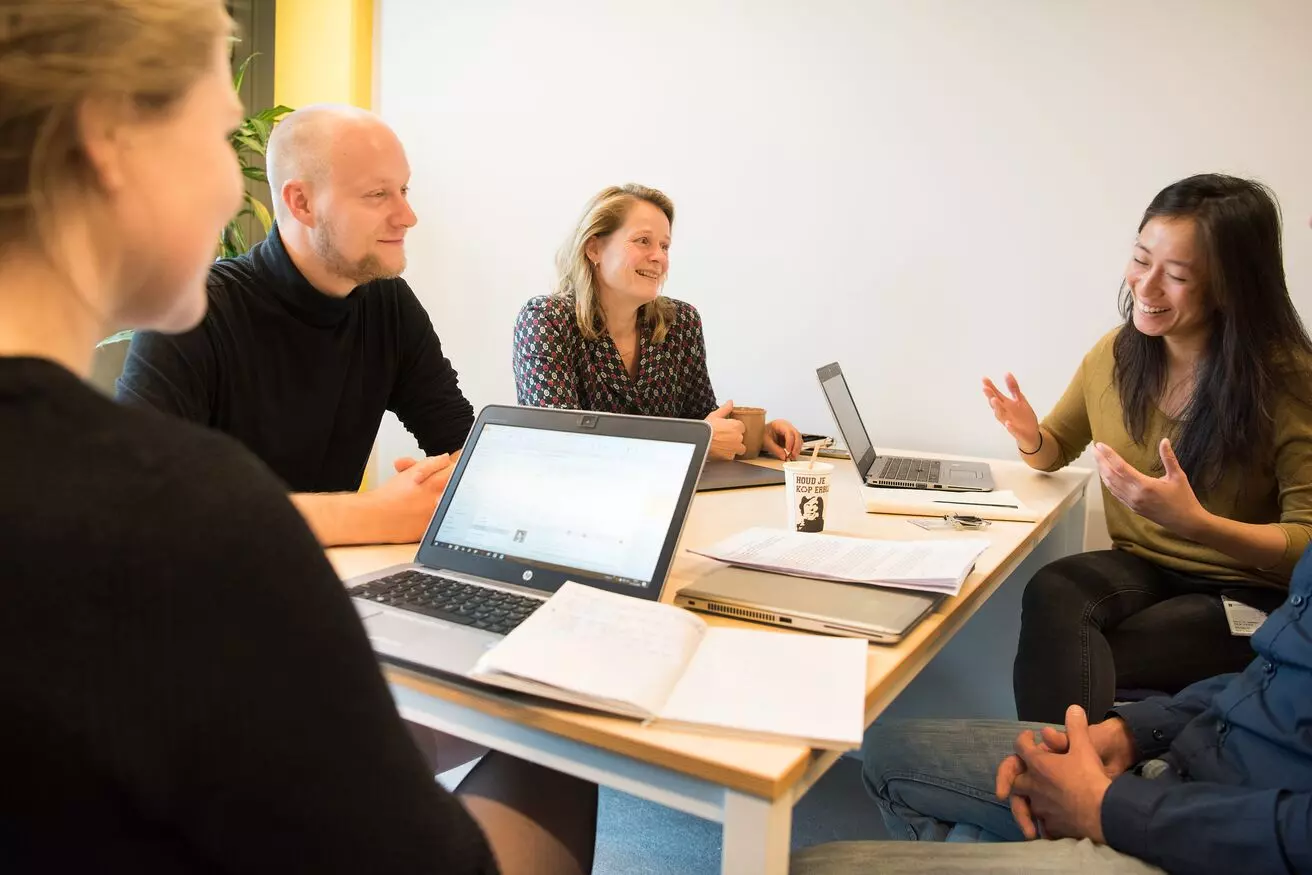
We are recruiting two PhD candidates for an interdisciplinary project on child language brokering - how multilingual children translate and mediate for others in everyday life. You will investigate how these experiences shape linguistic (this position) or socio-emotional development (the other position) in children and their parents. Are you interested in multilingualism, diverse research methods, and team science? Apply now!
PhD Position on Linguistic Effects of Child Language Brokering in Multilingual Families
- Faculty of Humanities
- 15497
- Master's
- €3,204 - €4,051
- 38 hours
- Closes on19-10-2026
Working at the UvA
About the position
Children from immigrant families often translate and mediate for others (typically their parents), a phenomenon called “child language brokering”. Brokering occurs in a variety of contexts: at home, at schools, and in medical offices. Research shows that child language brokering may have positive and negative effects on children’s socio-emotional development and on child-parent relationships, depending on when and where brokering occurs. There are also some indications that brokering affects children’s and parents’ development of the first and second language, but these effects remain largely unexplored.
In this PhD project, you will investigate how brokering experiences affect the maintenance of the heritage language and development of the second language in child brokers and their parents. The project is part of an NWO-funded project, consisting of two PhD students and a team of supervisors. The other PhD project focuses on the socio-emotional effects of brokering.
You will conduct a series of studies to investigate the effects of child brokering on the maintenance of the heritage language and development of the second language across more informal (home) and more formal (school, health care) contexts. You will also investigate what linguistic strategies are used during brokering, what beliefs brokers and parents hold about these strategies, and what opportunities for language learning emerge during brokering episodes. You will use a variety of methods, including observations, semi-structured interviews, controlled language tasks, as well as advanced statistics (network analysis). Together, the studies you will conduct will inform us about when and how brokering has positive effects on the use, maintenance and development of the heritage language and the second language in both child brokers and their parents.

Working at the UvA
About the position
Children from immigrant families often translate and mediate for others (typically their parents), a phenomenon called “child language brokering”. Brokering occurs in a variety of contexts: at home, at schools, and in medical offices. Research shows that child language brokering may have positive and negative effects on children’s socio-emotional development and on child-parent relationships, depending on when and where brokering occurs. There are also some indications that brokering affects children’s and parents’ development of the first and second language, but these effects remain largely unexplored.
In this PhD project, you will investigate how brokering experiences affect the maintenance of the heritage language and development of the second language in child brokers and their parents. The project is part of an NWO-funded project, consisting of two PhD students and a team of supervisors. The other PhD project focuses on the socio-emotional effects of brokering.
You will conduct a series of studies to investigate the effects of child brokering on the maintenance of the heritage language and development of the second language across more informal (home) and more formal (school, health care) contexts. You will also investigate what linguistic strategies are used during brokering, what beliefs brokers and parents hold about these strategies, and what opportunities for language learning emerge during brokering episodes. You will use a variety of methods, including observations, semi-structured interviews, controlled language tasks, as well as advanced statistics (network analysis). Together, the studies you will conduct will inform us about when and how brokering has positive effects on the use, maintenance and development of the heritage language and the second language in both child brokers and their parents.
All about this vacancy
This is what you will be doing
You will perform the following tasks and activities:
- reviewing literature on the effects of language brokering on the heritage and second language;
- carrying out in-depth studies to investigate the effects of child brokering on language development, as well as the linguistic strategies used during brokering and the opportunities to learn language during brokering;
- collaborating in an interdisciplinary research team;
- committing to open science practices such as pre-registering studies;
- contributing to knowledge utilization (outreach) activities undertaken by the team;
- submission of a PhD thesis within the period of appointment;
- presenting intermediate research results at workshops and conferences;
- participating in the Research School and Faculty of Humanities PhD training programmes;
- co-teaching courses at BA-level in the second and third year of the appointment (maximum 0,2 fte per year).
This is what we ask of you
- a completed Master's degree in Linguistics, Education, Psychology or a related field;
- excellent research skills demonstrated by a Master thesis;
- solid knowledge of quantitative and/or qualitative research methods;
- strong communicative and organizational skills, a cooperative attitude and commitment to team science;
- enthusiasm for communicating academic research to non-academic audiences;
- enthusiasm for teaching;
- participation in the ACLC and the national research school training program;
- excellent proficiency in English for academic purposes;
- (near-)native command in Dutch (C1-level or higher, or native) and working proficiency in a widely spoken heritage language (e.g., Arabic, Turkish, Polish) OR vice versa.
Please note that if you already hold a doctorate/PhD or are working towards obtaining a similar degree elsewhere, you will not be admitted to a doctoral programme at the UvA.
This is what else we offer you
- We offer a temporary employment contract for the period of 48 months. The first contract will be for 16 months, with an extension for the following 32 months, contingent on a positive performance evaluation within the first 12 months. The preferred starting date is 01 February 2027;
- Based on a full-time appointment (38 hours per week) the gross monthly salary will range from €3.204 in the first year to €4.051 (scale P) in the last year. This does not include 8% holiday allowance and 8,3% year-end allowance. The UFO profile PhD candidate applicable. The Collective Labour Agreement of Universities of the Netherlands is applicable;
- Excellent possibilities for further professional development and education;
- Excellent support research facilities (such as the Speech Lab);
- PhD candidates have free access to courses offered by the Graduate School of Humanities and the Dutch National Research Schools
All about this vacancy
This is what you will be doing
You will perform the following tasks and activities:
- reviewing literature on the effects of language brokering on the heritage and second language;
- carrying out in-depth studies to investigate the effects of child brokering on language development, as well as the linguistic strategies used during brokering and the opportunities to learn language during brokering;
- collaborating in an interdisciplinary research team;
- committing to open science practices such as pre-registering studies;
- contributing to knowledge utilization (outreach) activities undertaken by the team;
- submission of a PhD thesis within the period of appointment;
- presenting intermediate research results at workshops and conferences;
- participating in the Research School and Faculty of Humanities PhD training programmes;
- co-teaching courses at BA-level in the second and third year of the appointment (maximum 0,2 fte per year).
This is what we ask of you
- a completed Master's degree in Linguistics, Education, Psychology or a related field;
- excellent research skills demonstrated by a Master thesis;
- solid knowledge of quantitative and/or qualitative research methods;
- strong communicative and organizational skills, a cooperative attitude and commitment to team science;
- enthusiasm for communicating academic research to non-academic audiences;
- enthusiasm for teaching;
- participation in the ACLC and the national research school training program;
- excellent proficiency in English for academic purposes;
- (near-)native command in Dutch (C1-level or higher, or native) and working proficiency in a widely spoken heritage language (e.g., Arabic, Turkish, Polish) OR vice versa.
Please note that if you already hold a doctorate/PhD or are working towards obtaining a similar degree elsewhere, you will not be admitted to a doctoral programme at the UvA.
This is what else we offer you
- We offer a temporary employment contract for the period of 48 months. The first contract will be for 16 months, with an extension for the following 32 months, contingent on a positive performance evaluation within the first 12 months. The preferred starting date is 01 February 2027;
- Based on a full-time appointment (38 hours per week) the gross monthly salary will range from €3.204 in the first year to €4.051 (scale P) in the last year. This does not include 8% holiday allowance and 8,3% year-end allowance. The UFO profile PhD candidate applicable. The Collective Labour Agreement of Universities of the Netherlands is applicable;
- Excellent possibilities for further professional development and education;
- Excellent support research facilities (such as the Speech Lab);
- PhD candidates have free access to courses offered by the Graduate School of Humanities and the Dutch National Research Schools
Your place at the UvA
This is where you will be working
You will be appointed at the Amsterdam Center for Language and Communication (ACLC) as part of the project “Small voices, big words: Effects of child language brokering in immigrant families”, led by dr. Josje Verhagen and funded by the Dutch Research Council (NWO).
This project consists of two interconnected PhD projects: one looks at the effects of child language brokering on socio-emotional outcomes and the other at linguistic outcomes. Each PhD will have their own supervision team consisting of specialized members of staff (dr. Josje Verhagen and prof. dr. Sible Andringa for the present project). You will meet regularly within these teams as well as in the larger project team.
The Amsterdam Centre for Language and Communication is one of the five Research Schools within the Amsterdam Institute for Humanities Research. Within the University of Amsterdam, the ACLC represents a thriving linguistics community, home to several research groups that you can join. The current project falls under the Language Learning, Literacy and Multilingualism research group. The ACLC also has an active PhD community that meets formally and informally.
About the Faculty of Humanities
Your place at the UvA
This is where you will be working
This is where you will be working
You will be appointed at the Amsterdam Center for Language and Communication (ACLC) as part of the project “Small voices, big words: Effects of child language brokering in immigrant families”, led by dr. Josje Verhagen and funded by the Dutch Research Council (NWO).
This project consists of two interconnected PhD projects: one looks at the effects of child language brokering on socio-emotional outcomes and the other at linguistic outcomes. Each PhD will have their own supervision team consisting of specialized members of staff (dr. Josje Verhagen and prof. dr. Sible Andringa for the present project). You will meet regularly within these teams as well as in the larger project team.
The Amsterdam Centre for Language and Communication is one of the five Research Schools within the Amsterdam Institute for Humanities Research. Within the University of Amsterdam, the ACLC represents a thriving linguistics community, home to several research groups that you can join. The current project falls under the Language Learning, Literacy and Multilingualism research group. The ACLC also has an active PhD community that meets formally and informally.
About the Faculty of Humanities
Important to know
Your application & contact
Questions?
For questions about the position or department, you can contact dr. Josje Verhagen, [email protected]
Application
If you recognize yourself in the profile and are interested in this position (i.e., PhD 2 in the larger project), we look forward to receiving your application. Applications should include the following information (submitted in one .pdf):
- A letter of motivation.
- A full academic CV.
- A list of relevant BA modules and all Master-level modules you have taken, with an official transcript of grades.
- The names and contact details of two referents, including your thesis advisor, who may be approached by the selection committee.
- A writing sample, for example a published paper or (a chapter from) your MA thesis.
The vacancy closes on 19 October 2026. The first round of interviews will take place during the weeks of 16 or 23 November.
Diversity, Equity & Inclusion
Important to know
Your application & contact
Questions?
For questions about the position or department, you can contact dr. Josje Verhagen, [email protected]
Application
If you recognize yourself in the profile and are interested in this position (i.e., PhD 2 in the larger project), we look forward to receiving your application. Applications should include the following information (submitted in one .pdf):
- A letter of motivation.
- A full academic CV.
- A list of relevant BA modules and all Master-level modules you have taken, with an official transcript of grades.
- The names and contact details of two referents, including your thesis advisor, who may be approached by the selection committee.
- A writing sample, for example a published paper or (a chapter from) your MA thesis.
The vacancy closes on 19 October 2026. The first round of interviews will take place during the weeks of 16 or 23 November.
Other interesting vacancies for you
Postdoc Position on the Typology of Postverbal Negation, in a Multi-Method Crosslinguistic Project
- Faculty of Humanities
- €3,706 - €5,760
- Closes on08-11-2026
- PhD
- 30.4 hours

PhD in NWO Project CERRADO
- Faculty of Humanities
- €3,204 - €4,051
- Closes on29-10-2026
- University
- 38 hours
PhD Position on Socio-Emotional Effects of Child Language Brokering in Multilingual Families
- Faculty of Humanities
- €3,204 - €4,051
- Closes on19-10-2026
- Master's
- 38 hours
Other interesting vacancies for you

Postdoc Position on the Typology of Postverbal Negation, in a Multi-Method Crosslinguistic Project
- Faculty of Humanities
- €3,706 - €5,760
- Closes on08-11-2026
- PhD
- 30.4 hours
PhD in NWO Project CERRADO
- Faculty of Humanities
- €3,204 - €4,051
- Closes on29-10-2026
- University
- 38 hours
PhD Position on Socio-Emotional Effects of Child Language Brokering in Multilingual Families
- Faculty of Humanities
- €3,204 - €4,051
- Closes on19-10-2026
- Master's
- 38 hours

Don't miss out on your dream job!
Don't miss out on your dream job!
This website uses cookies
We, and third parties, use cookies on our website. We use cookies to ensure that our website functions properly, to store your preferences, to gain insight into visitor behavior, but also for marketing and social media purposes (showing personalized advertisements). By clicking 'Accept', you agree to the use of all cookies. In our Cookie Statement. you can read more about the cookies we use and save or change your preferences. By clicking 'Refuse' you only agree to the use of functional cookies.